
Dating Is Moving Offline (Singles Events Up 403%). Here’s How to Be Approachable in Real Life Again
The singles did not disappear. They moved to trivia nights, mahjong tables, run clubs, and birdwatching walks. The skill required to meet them there has not been used in a decade. This is the science-backed refresher.
On August 17, Fast Company reported on new data from Eventbrite comparing the first half of 2025 with the first half of 2026. The platform counted only events that signaled meeting intent, titles or descriptions with words like “singles,” “mixer,” or “meet new people.” Dating-minded trivia nights were up 403% year over year. Mahjong gatherings spiked 235%. Birdwatching meetups grew 131%, plant swaps 117%, pilates socials 84% [R1].
Two weeks earlier, the CEO of the company that owns Tinder and Hinge said the quiet part out loud on an earnings call: “Our internal research shows that nearly half of singles aged 18 to 29 want to share in-person experiences with people who could become closer connections” [R2]. Tinder is now racing to put on its own real-world events in 26-plus cities, because 53% of attendees at its Los Angeles pilot events came back for more [R2]. The LA Times summed up the company’s bind last year: people are dumping Tinder, and Tinder’s answer is getting singles offline [R3].
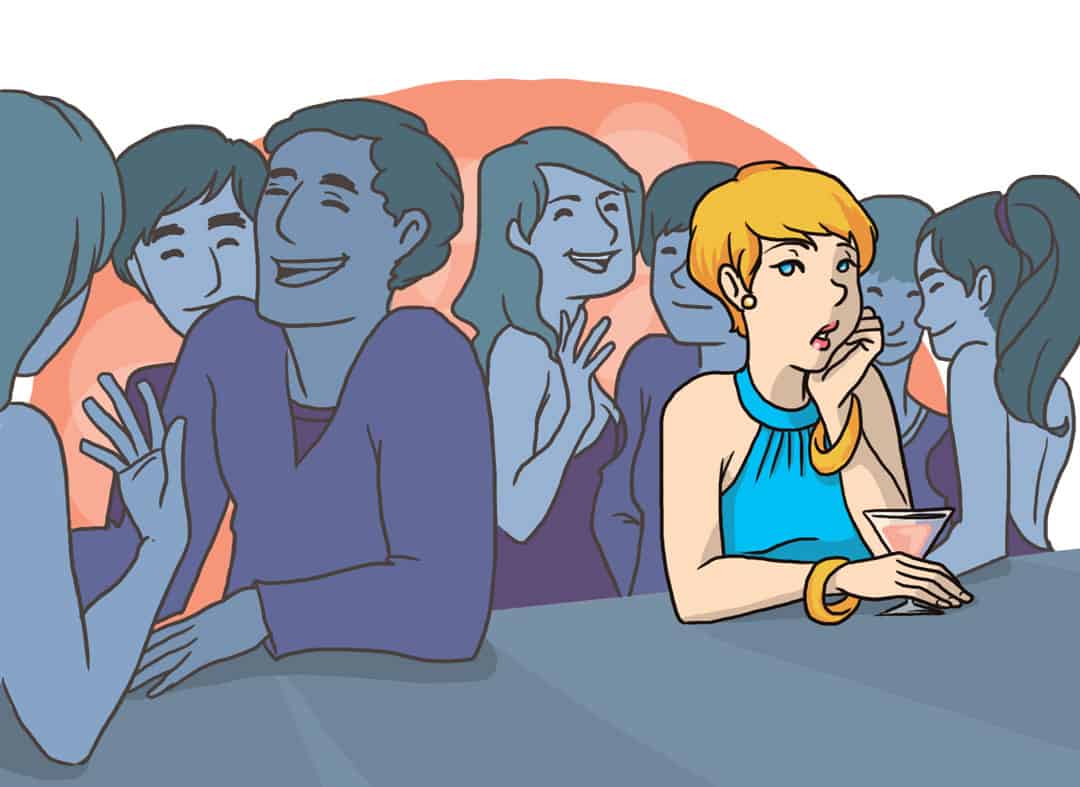
So the direction is clear, and this time it is measurable rather than anecdotal. What none of the coverage answers is the part that matters to you: when you actually show up to one of these rooms, what do you do? A generation of men learned to date inside an app, where the “approach” was a swipe and the opener was typed, edited, and sent to someone who had already signaled interest by matching. In a trivia room, none of that scaffolding exists.
Where the singles went: growth in meet-intent events, H1 2025 vs. H1 2026
The part nobody mentions: the offline muscle has atrophied
Here is the uncomfortable number underneath the trend. In a large dataset analyzed by Date Psychology, 29% of men said they have never approached a woman in person, and among men aged 18 to 25 the share rises to about 45% [R4]. Nearly half of the youngest dating-age men have never once done the thing that the entire offline pivot now requires.
It is not their fault, exactly. The infrastructure disappeared. Stanford’s long-running How Couples Meet and Stay Together study found that the share of couples who met online climbed from roughly 2% in 1995 to about 39% by 2017, while meeting through friends, historically the dominant channel, fell from about a third to about a fifth [R5]. For fifteen years, the culture outsourced initiation to software. Now the software’s own CEO is telling people to go outside, and nobody retrained the users.
That is actually good news for you. When a skill is rare, being merely competent at it stands out. And “approachable in real life” is a skill, not a personality type. The research below is the training manual.
Five findings that change how you show up
1. Talking to strangers goes better than your brain predicts
Commuters avoid conversation because they expect it to be awkward and unwelcome. In experiments by Nicholas Epley and Juliana Schroeder, commuters on trains and buses were assigned either to talk to a stranger or sit in solitude. The talkers had more positive commutes, the strangers were just as happy to be talked to, and nobody was rejected [R6]. The prediction error is the finding: we systematically underestimate how pleasant a short conversation with a stranger will be, for both sides. Your hesitation is not information. It is a miscalibrated forecast.
2. Familiarity does most of the work before you say anything
The mere exposure effect is one of the most replicated results in psychology: repeated, neutral exposure to a person increases liking [R7]. In a classic field demonstration, women who simply attended more sessions of a college course, without saying a word, were rated more attractive and more likable by classmates at the end of the term [R8]. The practical read: the man who shows up to the same run club three Tuesdays in a row is playing a different game than the man doing a one-night cold walk-up. Recurring events are not just where the singles are. They are the mechanism that makes you approachable. Buy the 4-class pass, not the drop-in.
3. Signals beat looks. Learn to read them before you move
Psychologist Monica Moore spent years observing women in bars and social settings and cataloged more than 50 nonverbal courtship signals: the glance-and-smile, the hair flip, the sustained look followed by looking away. Her key finding: a woman’s signaling behavior predicted whether men approached her better than her physical attractiveness did [R9]. Approaching is not supposed to be a blind leap. It is a response to an invitation. The skill is reading the invitation, and it is learnable, because the signals are consistent enough to table.
| Invitation cues (approach is welcome) | Busy cues (not now) |
|---|---|
| Repeated eye contact, especially look, smile, look away | Headphones in, eyes on phone or book |
| Orients her body toward the room, not a corner | Body angled away, closed posture, deep in a group conversation |
| Hovers near you or re-enters your space (bar, water table, trivia scoreboard) | Answers politely but gives short replies and turns back |
| Laughs or reacts to something you said to the room | Rushing, working, mid-workout with focus face |
Compiled from Moore’s observational catalog of solicitation behaviors [R9] and the gaze literature [R10]. One cue is noise; two or more is a pattern.
4. Eye contact is the cheapest approachability upgrade you own
Kleinke’s research review of gaze and eye contact found a consistent pattern: people who hold mutual gaze are rated as more likable and more attractive, and gaze enhances attraction when people are introduced [R10]. In a later experiment, pairs of strangers who held mutual gaze reported higher romantic attraction [R11]. You do not need a line. You need to look like someone who is comfortable being seen: eyes up, face available, a small smile when contact happens. Most men in public do the opposite, they armor up with the phone. Looking approachable is 80% of being approachable.
5. The best opener is a question, and the follow-up is the real move
Harvard researchers analyzed both lab conversations and real speed dates and found that people who ask more questions, especially follow-up questions, are better liked and win more second-date agreements [R12]. Follow-ups signal that you actually listened, which is rarer than confidence. This also solves the “what do I say” panic: at a hobby event, the context writes your opener for you. “Do you know what bird that is?” at a birdwatching walk, “Is this your first trivia night here?” at trivia, “Have you played mahjong before, because I have no idea what I’m doing” at a mahjong table. Situational, low-stakes, and it hands her an easy question to answer.
The playbook: your first four weeks back in the wild
Pick one recurring event and commit to four sessions
Trivia league, run club, mahjong night, climbing gym class. Recurrence is the strategy: mere exposure means session three is warmer than session one [R8]. Choose something you would enjoy even if nobody talked to you.
Week one: be visible, talk to everyone, flirt with no one
Arrive ten minutes early. Phone stays in the pocket. Make small situational comments to men and women alike: the bartender, the quizmaster, the person next to you. You are building the “he’s friendly” reputation that makes later approaches feel natural instead of targeted.
Week two: read signals and open one conversation
Use the signal table. Two or more invitation cues from the same person earns one situational question. Then ask a follow-up to whatever she answers [R12]. Goal is a pleasant three-minute conversation, not a number.
Week three: extend one good conversation
If the chat is going well, stay in it. Suggest a shared micro-activity: “Want to join our trivia team? We’re short a person,” or “I’m grabbing a coffee after the run, you’re welcome to join.” Low-pressure, easy to accept, easy to decline.
Week four: make the direct, gracious ask
“I’ve enjoyed talking with you. Want to grab a drink sometime this week?” Direct beats clever. If yes, get the number and text within 24 hours. If no, smile, say “No worries, see you next week,” and mean it. Graceful exits protect your reputation in a recurring room, and they are what make you safe to say yes to next time, for her or for anyone watching.
What to avoid
- One-night hunting. Showing up once, scanning the room, and leaving is app behavior ported into a physical space. Recurrence is the whole advantage.
- Ignoring busy cues. Headphones, books, and turned shoulders are answers. Respecting them is not defeat; it is what makes the room trust you.
- The monologue opener. A rehearsed routine signals that you approached a category, not a person. A situational question costs nothing and performs better [R12].
- Staying only where apps put you. Even Tinder is building IRL events now [R2]. The apps have conceded the venue. The skill is yours to build.
The 403% number is not really about trivia. It is about hundreds of thousands of people voting with their feet for the way couples met for all of human history: shared activity, repeated exposure, and someone eventually saying something. The research says the “something” is simpler than you fear, the reception is warmer than you predict, and the invitation is usually visible before you move. Go to week one.
Sources
- [R1] Snelling, G. (2026, Aug 17). “Gen Z is over dating apps. This 403% surge reveals what they’re doing instead.” Fast Company (Eventbrite data, H1 2025 vs. H1 2026).
- [R2] Castro-Sloboda, G. (2026, Aug 5). “Match Group’s CEO Says Gen Z Values In-Person Connection Over Dating Apps.” CNET.
- [R3] Wong, Q. (2025, Nov 14). “People are dumping Tinder. The dating app wants to reignite its spark by getting singles offline.” Los Angeles Times.
- [R4] Date Psychology (2023). “Risk Aversion and Dating.” datepsychology.com (29% of men never approached in person; ~45% among men 18-25).
- [R5] Rosenfeld, M. J., Thomas, R. J., & Hausen, S. (2019). “Disintermediating your friends: How online dating in the United States displaces other ways of meeting.” PNAS 116(36), How Couples Meet and Stay Together surveys.
- [R6] Epley, N., & Schroeder, J. (2014). “Mistakenly seeking solitude.” Journal of Experimental Psychology: General, 143(5).
- [R7] Zajonc, R. B. (1968). “Attitudinal effects of mere exposure.” Journal of Personality and Social Psychology, 9(2, Pt. 2).
- [R8] Moreland, R. L., & Beach, S. R. (1992). “Exposure effects in the classroom: The development of affinity among students.” Journal of Experimental Social Psychology, 28(3). (See also Moreland & Zajonc, 1982.)
- [R9] Moore, M. M. (1985). “Nonverbal courtship patterns in women: Context and consequences.” Ethology and Sociobiology, 6(4); Moore, M. M. (2010). “Human nonverbal courtship behavior: A brief historical review.” Journal of Sex Research, 47(2-3).
- [R10] Kleinke, C. L. (1986). “Gaze and eye contact: A research review.” Psychological Bulletin, 100(1).
- [R11] Williams, G. P., & Kleinke, C. L. (1993). “Effects of mutual gaze and touch on attraction, mood, and cardiovascular reactivity.” Journal of Research in Personality, 27(2).
- [R12] Huang, K., Yeomans, M., Brooks, A. W., Minson, J., & Gino, F. (2017). “It doesn’t hurt to ask: Question-asking increases liking.” Journal of Personality and Social Psychology, 113(3).