

Tinder’s AI Wants Your Entire Camera Roll. Here’s What “Chemistry” Actually Does With Your Photos
Tinder is rolling out an opt-in scan of every photo on your phone, in exchange for AI-picked profile pictures and curated matches. We read the company’s actual policy line by line. Here is what gets uploaded, what gets kept for 90 days, and whether any evidence shows it wins you more dates.
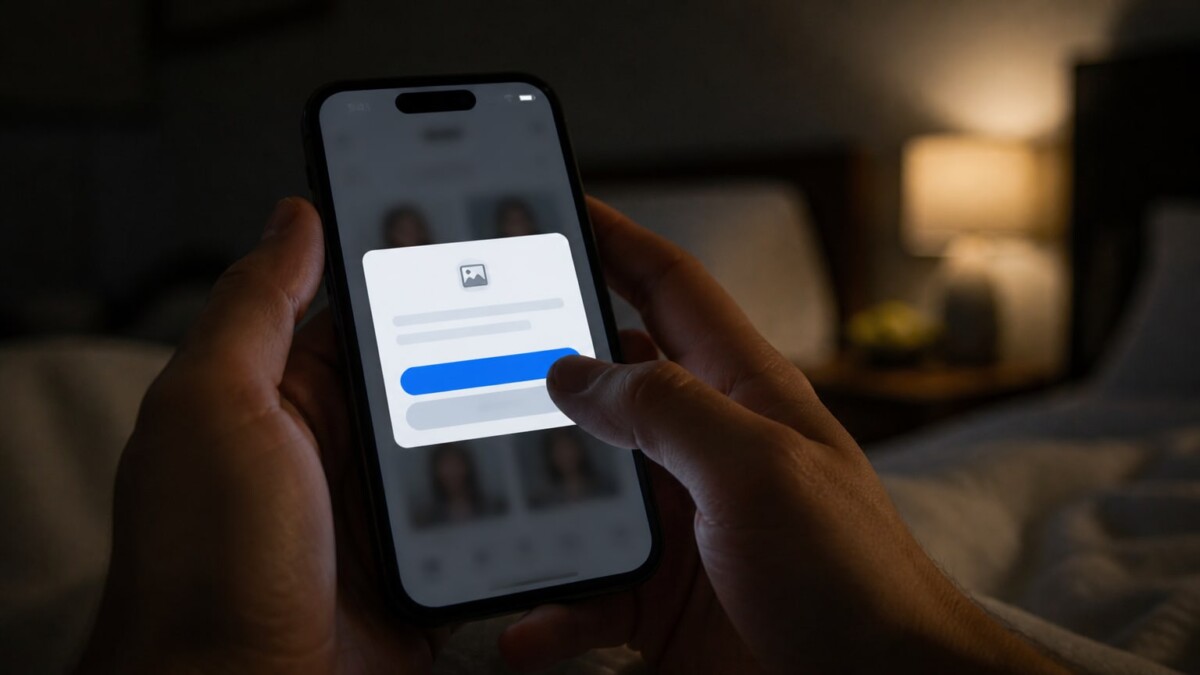
If you use Tinder in the United States or Canada, a new permission screen is coming for your camera roll. The app’s new AI feature, Chemistry, asks for permission to scan your phone’s entire photo library, judge the recurring themes in it, and use what it learns to pick your profile pictures and curate your daily matches. Tinder calls the output “Photo Insights”: short descriptions of your interests, personality, and lifestyle, generated by a machine learning model that has looked at pictures you never intended to show anyone.[6]
The pitch is seductive for anyone who has stared at their own camera roll wondering which photo to lead with. The fine print is more complicated. Tinder’s policy says select photos are temporarily uploaded to the company’s servers and shared with an unnamed third-party AI provider, that a personality profile distilled from your un-posted photos can sit in your account for up to 90 days, and that you cannot choose which photos the scan covers. It covers all of them.[6][10]
Whether the trade is worth it depends on a question Tinder has not answered with data: does Chemistry actually get you more matches? As of this writing, the company has published no results. Below, what the feature does step by step, what the policy buries, what the science of attraction says about “vibe matching,” and how to decide when the prompt appears on your screen.
What Chemistry is, and where it is live
Chemistry is an AI-driven matching layer announced by Match Group CEO Spencer Rascoff on the company’s third-quarter 2025 earnings call. Match described it as an interactive feature designed to combat “swipe fatigue” by surfacing fewer, more compatible matches, and called it “a major pillar of Tinder’s upcoming 2026 product experience.”[1][2] The pilot went live in New Zealand and Australia in late 2025.[1]
The feature combines three inputs: your answers to conversational prompts, your written profile, and, if you allow it, an analysis of your camera roll. That third input is generated by a companion feature, Photo Insights, which Tinder’s help center describes as “short descriptions of your interests, personality, or lifestyle generated by analyzing patterns in your photo library.”[6] The combined picture then feeds daily curated recommendations instead of an open-ended swipe queue. A Tinder spokesperson told Gizmodo the goal is “surfacing a few highly relevant profiles each day.”[3]
At Tinder’s first product keynote, Sparks 2026, on March 12, 2026, the company listed Chemistry and Camera Roll Scan among its ten major innovations and confirmed expansion into the United States and Canada through 2026.[5][12] In some markets, the scan prompt now appears during sign-up itself, which means new users meet it before they have sent a single message.[6]
Why Tinder wants your photos now: the subscriber math
This feature is a retention bet, and the balance sheet explains the urgency. As of Tinder’s third quarter of 2025, the app had posted nine straight quarters of paying subscriber declines, with revenue down 3 percent and paying users down 7 percent year over year.[2][4] Match even guided its fourth-quarter outlook lower, citing a $14 million negative impact on Tinder’s direct revenue from the product testing itself.[2]
The slide continued into 2026. In Match’s second quarter of 2026, reported August 4, group paying users fell 6 percent year over year to 13.3 million, total revenue dipped 1 percent to $853 million, and Tinder’s monthly active users dropped 7 percent, though Tinder’s daily active user decline narrowed to 4 percent, which Rascoff called its best performance on that metric in ten quarters.[13] Meanwhile Hinge, Match’s sibling app, grew direct revenue 22 percent with paying users up 17 percent, a contrast Match’s management now has to answer for on every earnings call.[13][4]
Read that sequence and the product strategy becomes legible. Match is spending money it does not have, on a feature with no published results, because the old model of endless swiping is losing users. The camera roll is the richest untapped signal Tinder has access to, and the company is asking for it the way every data-hungry platform does: wrapped in a benefit to you. Whether the benefit is real is the question the rest of this article answers.
What happens when you tap Allow: six steps
Tinder’s help center lays the process out in four stages. Compressed into plain English, here is the full path your photos travel once you opt in, with the retention rules attached to each step.[6]
The fine print, translated: four things the policy buries
Most coverage of Chemistry has repeated Tinder’s assurances without opening the document behind them. We read the help article in full. Four clauses deserve your attention before you consent to anything.
“The identified photos are temporarily uploaded to Tinder’s servers and shared with our AI technology provider solely to create Photo Insights.”
“Your Photo Insights will be available in your Insights Hub and used to help Tinder personalize your experience and better connect you with others. We may also analyze Photo Insights to help us improve the feature. Photo Insights you don’t keep are deleted within 90 days.”
“We perform an on-device scan of your camera roll to identify photos that we think could produce relevant insights about you, based on photo quality, content, and similarity.”
“Tinder doesn’t collect, store, access or otherwise receive any biometric data generated from your selfie, profile photo, or photos on your camera roll… all biometric data used as part of this feature is deleted from your device once you exit the feature. Your selfie is also deleted.”
The data lifecycle in one table
| Your data | Where processed | Who sees it | How long kept | Can you stop it |
|---|---|---|---|---|
| Entire camera roll (scan for quality, content, similarity) | On your device only | Tinder’s on-device scan code | Never stored | Yes: opt in is voluntary; revoke photo access in phone settings anytime |
| Selected photos (chosen by the scan, not you) | Tinder’s servers | Tinder + unnamed AI provider | Deleted after insights generated, unless you post them | Partially: cannot exclude specific photos |
| Photo Insights (your interests, personality, lifestyle) | Server-side | Tinder; may be re-analyzed to improve the feature | Up to 90 days if you don’t keep them (promptly deleted in some markets) | Yes: delete insights you don’t want in the Insights Hub |
| Biometric face data (from your selfie or profile photo) | On your device only | Nobody, per Tinder’s policy | Deleted when you exit the feature; selfie deleted | Yes: this layer is fully optional |
| Anything posted to your profile | Tinder’s servers | Public, like any profile content | Until you remove it | Yes: nothing posts without your approval |
What Tinder promises, and what the fine print leaves open
The biometric layer: how the selfie fits in
Photo Insights has an optional second gear. If you want photo suggestions that actually feature you, Tinder asks you to supply a reference image, either by pointing to a photo of yourself in your camera roll, taking a selfie, or using an existing solo profile photo. The app generates biometric data from that reference and uses it to find your face across your library.[6]
Two things to know about this layer. First, Tinder’s policy language is as protective as it gets: no biometric data is collected, stored, or received by the company, everything runs on-device, and both the biometric data and the selfie are deleted when you exit the feature.[6] Second, skip it and the feature degrades. Daily Dot notes that without the biometric option, the photos Tinder suggests “might not include you at all,” which blunts the main selling point for a dating profile.[8] In other words, the optional layer is where the visible value lives, which makes the consent design a genuine trade and not a formality.
Does opting in get you more matches? The evidence gap
Every privacy cost above would be easier to swallow if Chemistry demonstrably worked. Here is where the story gets thin. We reviewed Tinder’s Sparks 2026 press materials and Match’s investor statements, and there is no published outcome data for Chemistry. The keynote release attaches internal statistics to several features: survey numbers for Double Date, swipe-rate tests for Astrology Mode, a 14-million-user test for Learning Mode. Chemistry and Camera Roll Scan get one descriptive line each and no numbers.[5]
The only Chemistry-related figure Match has given investors is a cost: the $14 million drag on Tinder’s direct revenue attributed to product testing.[2] Nine months after the New Zealand and Australia pilot began, no match-rate, conversation-rate, or retention results have followed. We asked what the company could point to by checking its newsroom and help documentation; neither offers any. Absent evidence, treat the benefit claim as a hypothesis.
The scientific record gives reason for skepticism about the specific promise of “vibe matching.” In a 2017 study published in Psychological Science, Samantha Joel, Paul Eastwick, and Eli Finkel trained machine learning models on data from speed-dating events, using more than 100 variables measured before participants met. The models reliably predicted actor effects (how much a person tends to like others in general) and partner effects (how much a person tends to be liked), but the unique attraction between two specific people, the actual chemistry of the pair, was barely predictable from anything collected before the meeting.[14]
A landmark review by Finkel and colleagues in Psychological Science in the Public Interest reached the broader conclusion years earlier: no published evidence shows that algorithmic matching produces better romantic outcomes than introducing people without an algorithm, because similarity on measurable traits is a weak predictor of relationship success, and the interaction dynamics that actually determine a spark cannot be observed before two people meet.[15]
Then there is the inference problem, best summarized by the r/technology user who pointed out that he takes thousands of photos of boats for work and hates boats. A camera roll records what you photograph, which includes your job, your family, your documents, and your memes. It does not record what you value. A theme classifier reading that archive will confidently mistake obligations for hobbies, and Chemistry then steers your match queue with those mistakes. One commenter with a camera roll full of kids’ photos joked that the algorithm would conclude he was “into…kids.” The joke lands because the failure mode is real.[11]
The reaction so far
The backlash arrived with the US announcement. The New York Post ran coverage describing the feature as creepy and all-access, and quoted critics who were less diplomatic.[7]
“Tinder just built a surveillance feature and called it a personality quiz. The camera roll is the most intimate dataset on your phone.” Tech critic quoted by the New York Post, March 2026[7]
“Your entire camera roll, every photo, every screenshot, every random meme you saved at 2am. They say it’s to understand your vibe. When tech companies say ‘vibe’ they usually mean data. Never ever get trapped into this.” Post on X, quoted by the New York Post[7]
On Reddit, a thread in r/technology about the scan drew 1,271 points and 264 comments within a day, with a 94 percent upvote ratio. The top comment, at 1,153 points: “You know, I think I’d rather die single and alone, thanks.”[11] That is the loudest audience signal available right now, and Tinder’s product team has seen it too. The company has responded by leaning harder on the opt-in framing and the on-device language, not by publishing results.
Should you opt in? A decision guide
Photos of documents, medical images, someone else’s intimate photos, pictures you’d never show a date. Remember: you cannot exclude specific photos from the scan.[10]
If you opt in: five ways to shrink the footprint
- Skip the biometric selfie unless you genuinely need face-based suggestions. It is optional, and without it the rest still runs.
- Revoke camera roll access the moment the scan finishes. On both iOS and Android this lives in your system settings under Tinder’s permissions. The insights already generated keep working; the app loses ongoing access to your library.
- Review your Insights Hub and delete insights that misread you (the boats problem). These tags steer both your suggestions and your match queue.
- Don’t keep insights you don’t use. Un-kept insights are scheduled for deletion within 90 days; keeping them keeps them.[6]
- Watch the sign-up flow. In some markets the scan prompt appears during registration. You can skip it entirely and use no suggestions at all.[6]
The bottom line
Chemistry is Tinder’s most ambitious attempt to rebuild around quality instead of volume, and its privacy engineering is better than the headlines suggest: real opt-in, on-device scanning, on-device biometrics, and nothing posted without consent. The gaps are real too. An unnamed third party touches your selected photos. A personality profile built from your private images can persist for up to 90 days and feed product development. The scan cannot be scoped. And the company asking for your most intimate dataset has not shown you a single number proving the exchange pays off in dates.
Until it does, the rational move for most men is to treat the camera roll scan as exactly what it is: a generous gift of information to an app that is losing subscribers, in exchange for an unproven promise. Keep your library to yourself, pick your own photos, and let the person across the table be the algorithm that decides whether there’s chemistry.
Sources
- Jess Weatherbed, “Tinder’s AI can find better matches by scanning your camera roll,” The Verge, November 6, 2025.
- Sarah Perez, “Tinder to use AI to get to know users, tap into their Camera Roll photos,” TechCrunch, November 5, 2025.
- Matt Novak, “Tinder is Testing AI Features That Look Through Your Camera Roll,” Gizmodo, November 5, 2025.
- Anna Iovine, “Tinder is testing an AI matching feature called Chemistry,” Mashable, November 6, 2025.
- “Tinder Debuts Inaugural Product Keynote Tinder Sparks 2026: Start Something New,” Tinder Newsroom, March 12, 2026.
- “Photo Insights,” Tinder Help Center, updated July 30, 2026. All policy quotations in this article come from this page.
- “Tinder’s new AI camera roll scan blasted by online critics,” New York Post, March 18, 2026.
- Rachel Kiley, “Tinder’s AI will analyze your camera roll to discover your ‘vibe’,” Daily Dot, March 17, 2026.
- Niamh Ancell, “Tinder’s AI wants to scan your camera roll: this is why you should opt out,” Cybernews, March 20, 2026. Aras Nazarovas quotations from the same piece.
- Megan Farokhmanesh, “Tinder Plans to Let AI Scan Your Camera Roll,” 404 Media, March 19, 2026 (Mark Kantor quotations and safeguard details).
- “Tinder Plans to Let AI Scan Your Camera Roll,” r/technology, March 19, 2026. Thread engagement as of retrieval.
- Jony, “Tinder’s New AI Tool ‘Chemistry’ Scans Camera Rolls for Better Matches in USA,” Hypefresh, March 14, 2026.
- “Match Group Announces Second Quarter Results,” Match Group press release, August 4, 2026.
- Samantha Joel, Paul W. Eastwick, and Eli J. Finkel, “Is Romantic Desire Predictable? Machine Learning Applied to Initial Romantic Attraction,” Psychological Science, 2017.
- Eli J. Finkel, Paul W. Eastwick, Benjamin R. Karney, Harry T. Reis, and Susan Sprecher, “Online Dating: A Critical Analysis From the Perspective of Psychological Science,” Psychological Science in the Public Interest, 2007.